

The sports industry is consolidating. Is your infrastructure keeping up?
Consolidation or Automation?
For years, sports organizations have added technology one problem at a time. A ticketing platform to sell seats. A CRM to manage customers. A campaign tool to engage fans. A loyalty program to reward them. An advertising platform to reach them. Another dashboard to measure everything.
Each investment made sense on its own. Collectively, many organizations have ended up with a fan technology stack that is difficult to understand, harder to operate and nearly impossible to learn from as one system. The same fan might exist as a ticket buyer, campaign entrant, merchandise customer, loyalty member and mobile-app user. To the fan, these are all interactions with the same organization. Inside the organization, they may be five different people.
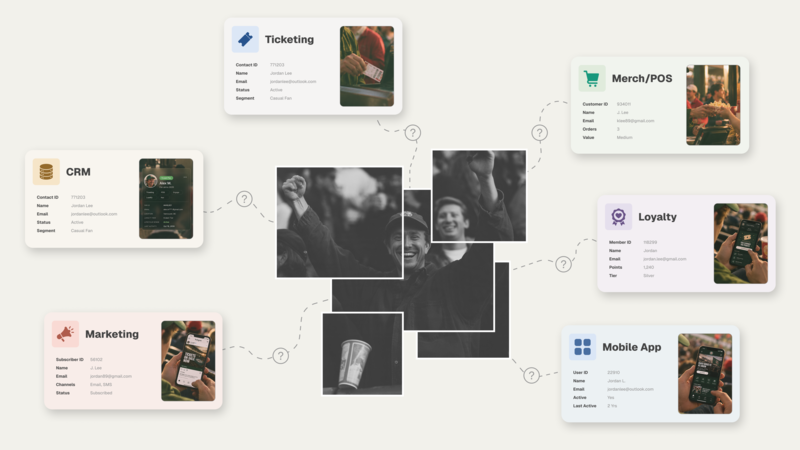
That gap has always created inefficiency.
As enterprise AI moves from experimentation into real workflows, it is becoming a strategic liability. AI can make decisions and execute work faster than previous technology. But it cannot reliably compensate for conflicting identities, disconnected systems, inconsistent definitions or data with unclear permissions.
Before organizations automate more of the fan relationship, they need to connect it.
They need to consolidate before they automate.
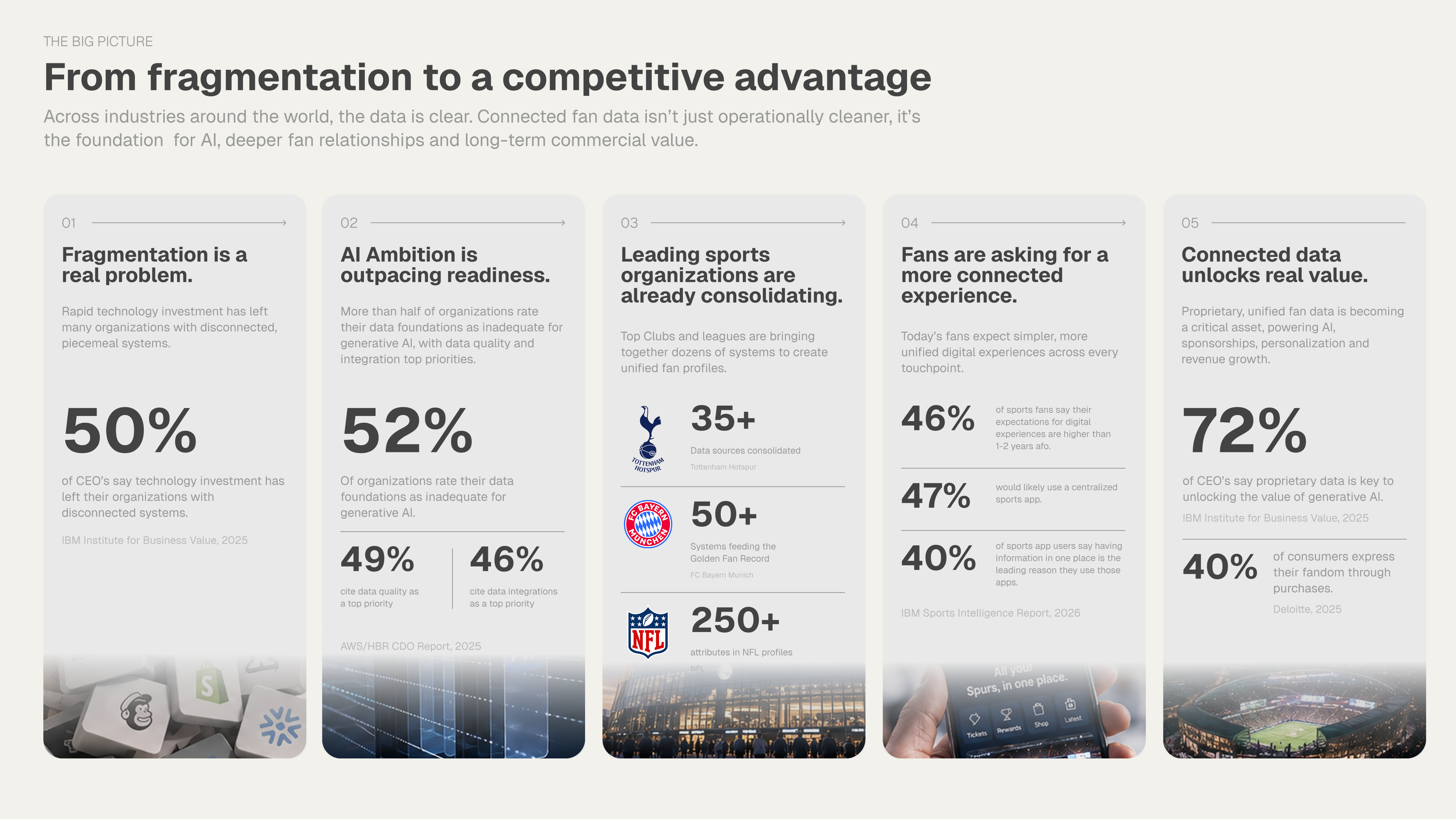
Consolidation is already happening
Consolidation is often discussed as a procurement exercise: reduce the number of vendors, simplify contracts and cut technology costs. That is part of the story, but it misses the larger shift. Across sports and entertainment, platforms are consolidating around the complete audience lifecycle.
Ticketing companies are expanding into event discovery, promotion, venue operations and experience development. Advertising companies are combining media execution with purchase and location data. Live-event businesses are investing in venues, production infrastructure and owned intellectual property.
The commercial advantage is not simply having more products under one company. It is owning more of the learning loop. A platform that can observe what people discover, click, attend, purchase and return to can understand demand in ways a standalone tool cannot. Every transaction improves its ability to decide what to promote, where to invest and which audiences to pursue next.
That intelligence compounds.
The risk for sports organizations is not only that they will have too many tools. It is that an outside platform could eventually understand and activate their audience better than they can.
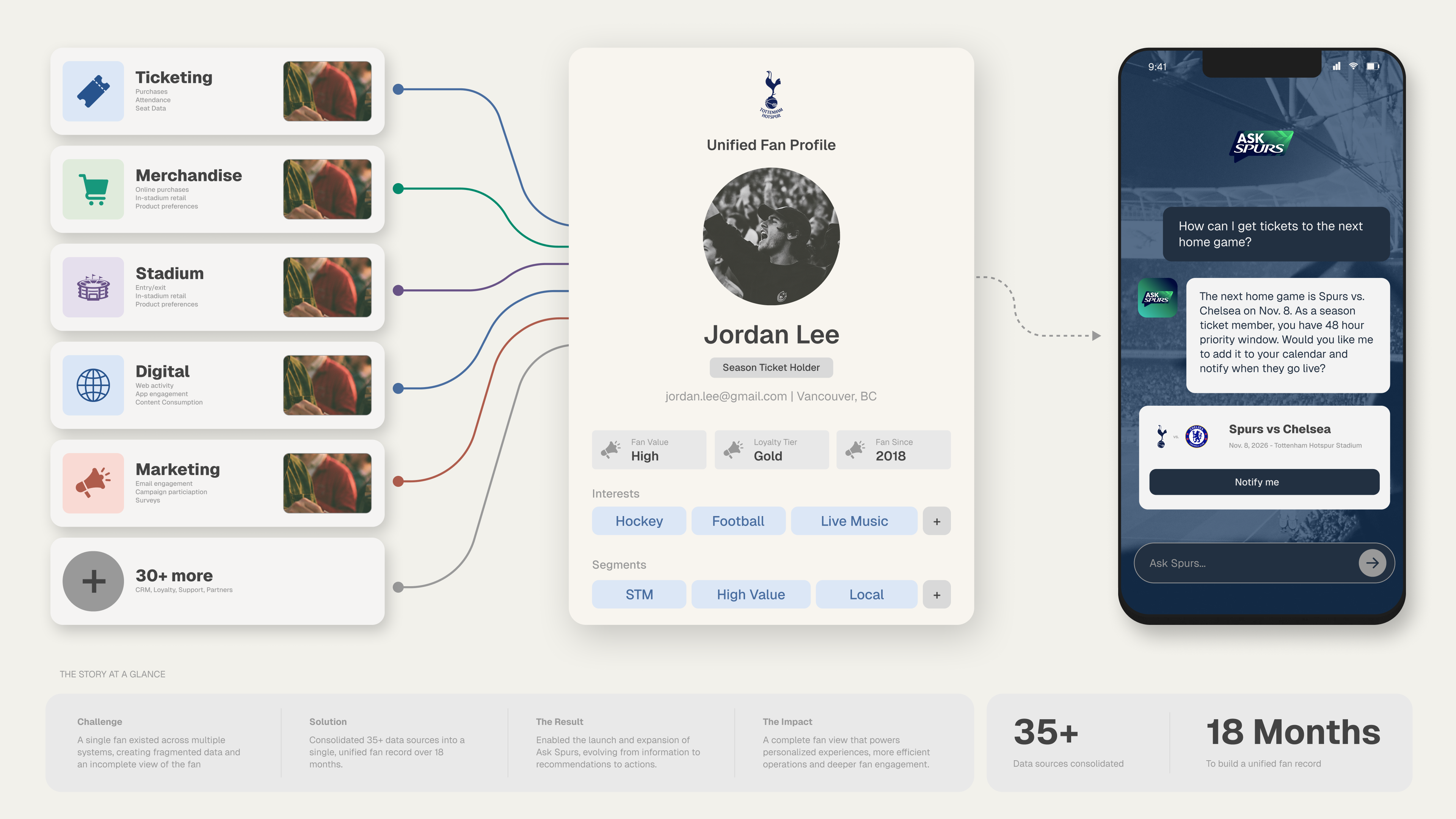
One fan. Thirty-five systems.
Tottenham Hotspur recently offered a useful illustration of the problem.
Before expanding its Ask Spurs AI assistant, the club spent 18 months consolidating more than 35 data sources into a single fan record.
The problem was not a lack of data. It was that the same supporter could appear differently across ticketing, merchandise, stadium attractions and other systems. Until those identities were reconciled, the club could not reliably understand the complete relationship.
Only after completing that foundational work could Tottenham begin evolving Ask Spurs from a multilingual information assistant into something more transactional.
The progression is important:
Question to answer. --> Question to recommendation. --> Question to action.
The AI interface may be the most visible part of that transformation, but it is not the most important. The critical work happened underneath it.
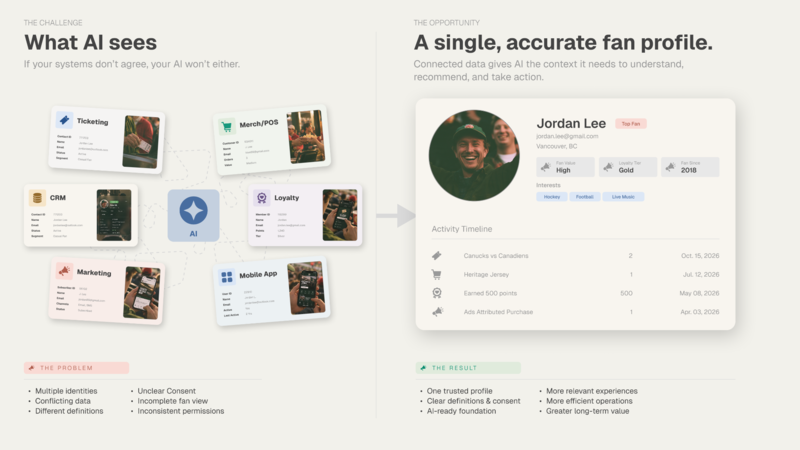
AI does not eliminate the integration problem
There is an understandable hope that artificial intelligence will make fragmented systems easier to use. In some cases, it will. A conversational interface can make it easier to ask questions, retrieve information and initiate workflows across complex technology. Teams may no longer need to understand every dashboard, database or menu. But that does not mean the underlying systems can disagree.
Ask an AI assistant how many high-value fans are at risk of lapsing and it still needs to know:
- What qualifies someone as a fan?
- Which profile is accurate?
- What counts as high value?
- What behaviour indicates a lapse?
- Which transactions belong to the same person?
- What communications has that person consented to receive?
- Which actions is the assistant permitted to take?
If the organization has five answers to each question, the agent does not magically discover the correct one. It processes the inconsistency faster. That is why the next stage of enterprise AI will be shaped less by who has the most impressive chatbot and more by who has the strongest operational foundation. Reliable enterprise AI requires connected data, shared definitions, governed access and clear pathways from insight to action.
The objective is not to eliminate every logo from the technology diagram. It is to eliminate the gaps in the fan journey.
Consolidation does not mean one enormous platform
This argument can easily be mistaken for a call to replace every specialized system with one vendor. It’s not. Sports and entertainment organizations have complex requirements. Ticketing, commerce, venue operations, content, advertising and fan engagement will continue to involve specialized technology. A single platform may not be the best system for every job. The objective is not to eliminate every logo from the technology diagram. It is to eliminate the gaps in the fan journey.
Organizations need to consolidate the elements that must operate consistently across the business:
IDENTITY
Is the ticket buyer the same person as the loyalty member, campaign entrant and merchandise customer?
INTELLIGENCE
Do teams share definitions for engagement, value, affinity, purchase intent and retention?
ACTIVATION
Can an audience insight become a campaign, advertising segment, loyalty journey or service action without starting again in another system?
GOVERNANCE
Does the organization know where its data came from, what the fan consented to and how that information may be used?
MEASUREMENT
Do campaign, advertising and loyalty outcomes return to the fan profile and improve the next decision?
This is not necessarily vendor consolidation. It is operational consolidation across a connected ecosystem.
The campaign era is ending
Many fan technology stacks were built for campaigns.
A team wanted to launch a sweepstakes, collect registrations, send an email or advertise a ticket offer. Each campaign had its own objective, creative, audience and report. That model can generate strong short-term results. But too often, the learning disappears when the campaign ends. The next campaign starts with another audience pull, another manual brief and another attempt to understand what happened previously.
Modern fan infrastructure should work differently.
Every campaign should improve the organization’s understanding of the fan. Every new data source should enrich a persistent identity. Every result should inform the next audience, offer or experience. The campaign still matters. It simply becomes part of a larger system.
Instead of asking, “How did this campaign perform?” organizations can begin asking:
- What did this interaction teach us?
- Which fan profiles became more valuable?
- What behaviour changed?
- Which audiences should receive a different experience next time?
- What can our teams now do that they could not do before?
That is the shift from running campaigns to building an audience ecosystem.
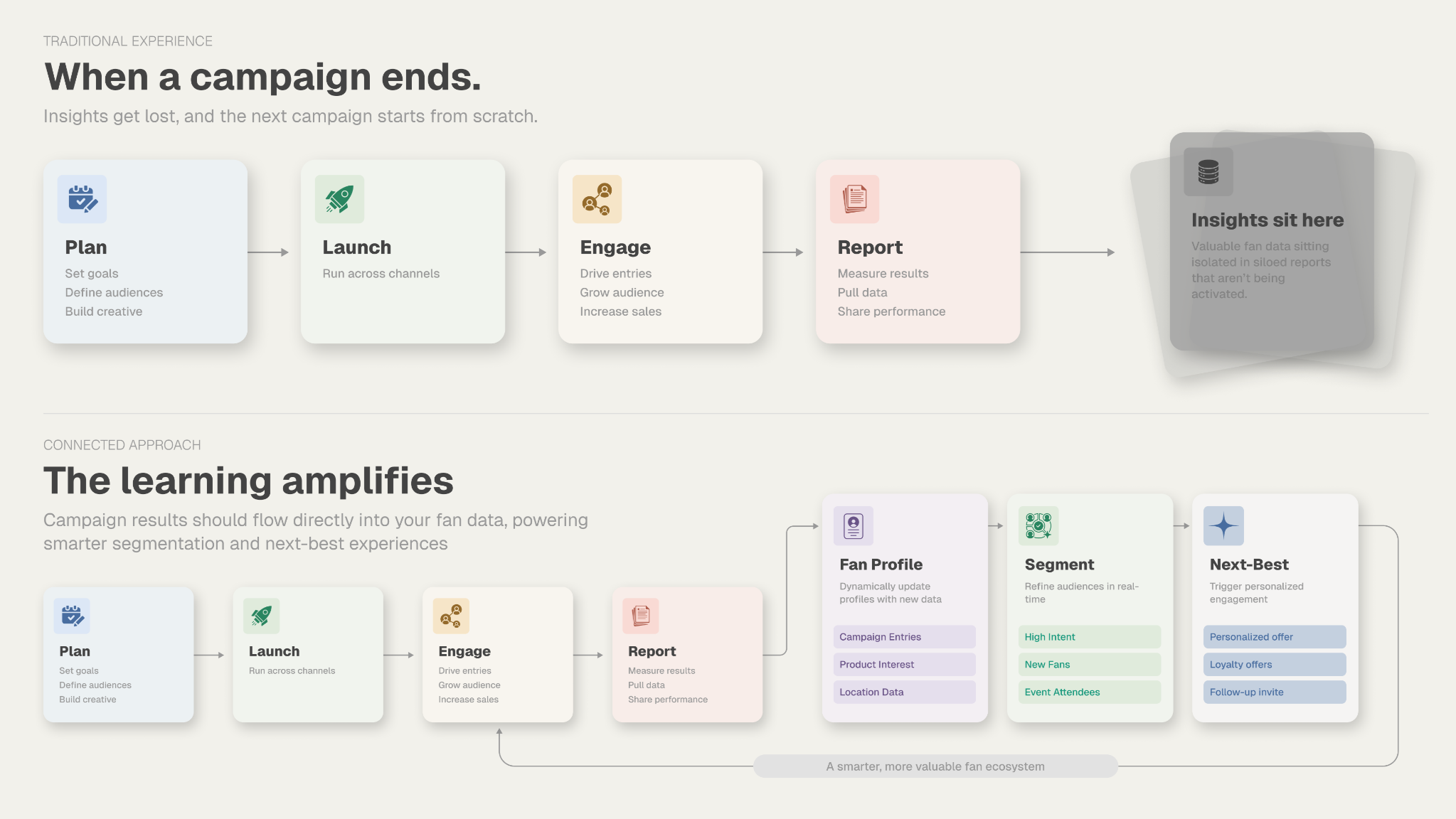
The organizations that connect first will learn faster
The strongest argument for consolidation is not efficiency.
It is speed of learning. When fan identity, engagement, intelligence and activation are connected, every interaction makes the organization more capable.
A prediction game reveals team or player affinity. A theme night introduces a new audience cohort. A ticket transfer identifies the person who actually attended. A loyalty challenge shows which reward changes behaviour. An advertising campaign reveals which audience converted.
Individually, these are useful signals.
Connected to one fan profile and one intelligence layer, they become organizational knowledge. That knowledge can improve segmentation, creative strategy, ticket offers, sponsorship activation, retention planning and eventually the recommendations made by enterprise AI.
The advantage compounds because the organization does not merely collect more data. It gets better at using every interaction.
Are you ready to automate the fan relationship?
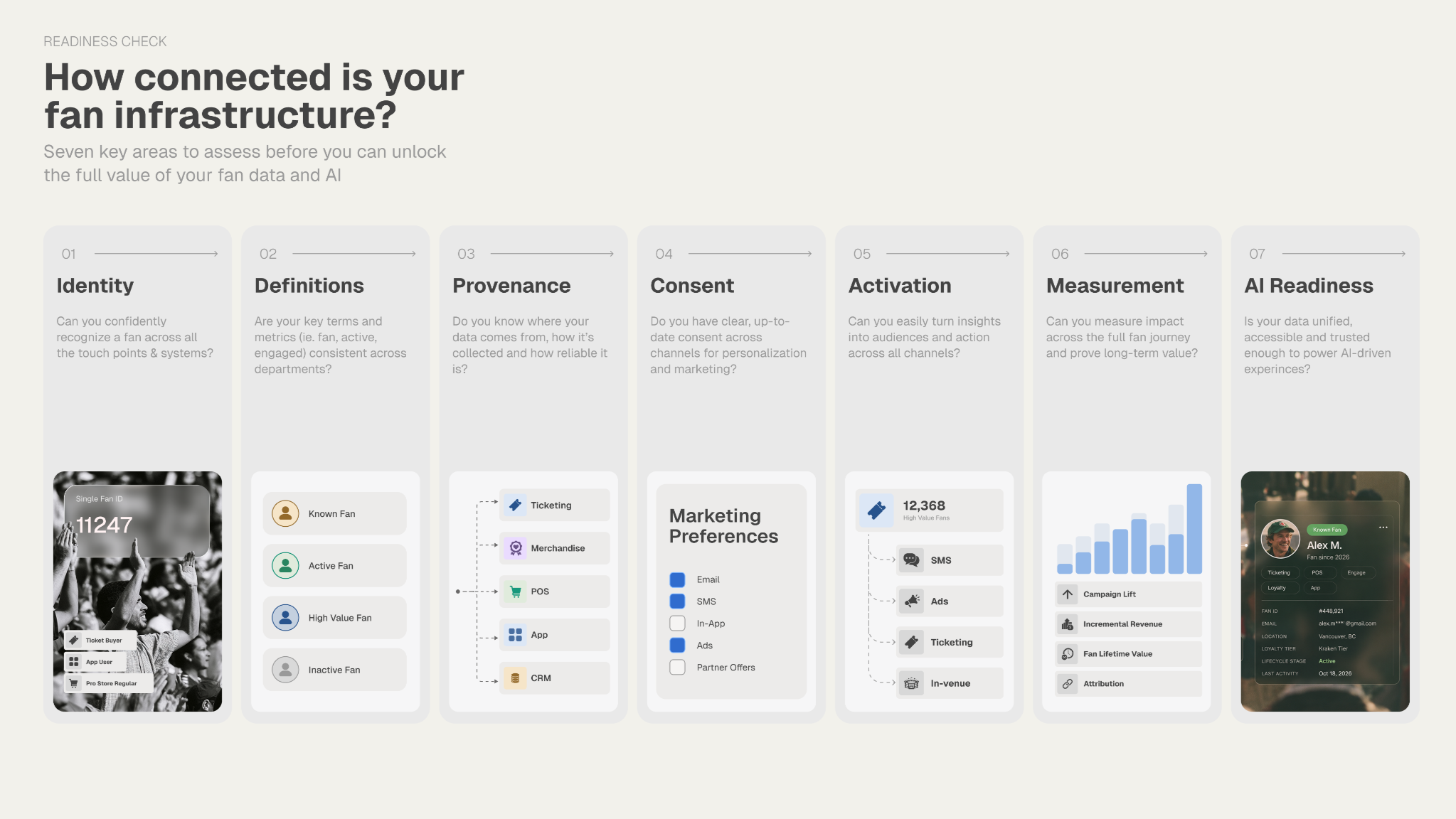
Before introducing enterprise AI or adding another fan-facing platform, organizations should ask a few basic questions:
- Can we reconcile fan identities across our major systems?
- Do departments use the same definitions for engagement and value?
- Can we identify the source of an audience insight?
- Are consent and permitted uses connected to the data?
- Can an insight become an approved action without extensive manual work?
- Can we measure the result against the same fan profiles?
- Would an AI agent receive one reliable answer or several conflicting ones?
If those questions are difficult to answer, the immediate need may not be another AI pilot. It may be infrastructure.
The goal is not simply fewer tools
Consolidation should not be measured by the number of contracts eliminated. It should be measured by what the organization can understand and do as a result.
Can teams recognize the same fan? Can they act on the same intelligence? Can they launch experiences without rebuilding the audience every time? Can they determine which engagement actually changed behaviour? Can their systems and future AI capabilities operate using the same trusted language?
The future of fan engagement will not belong to the organizations with the most campaigns, the most data or the longest list of technology partners. It will belong to the organizations that can connect those capabilities into a system that improves with every fan interaction.
Before you automate more, consolidate what needs to work together.
Take the Quiz!
The Modern Fan Industry is shifting. Get insights straight to your inbox.